
What kind of data you can get out of TriNetX, how private it is, and what you need from the IRB for each kind.
Identified versus de-identified
Patient data that institutions send to TriNetX is de-identified before it is sent, or is a Limited Data Set.
| Data access mechanism | PHI status | Notes |
|---|---|---|
| Data of any network stays in the platform | De-identified | Individual patients can't be identified; no individual patient data is accessed |
| Dataset download, Research or Linked networks | De-identified | Individual patients can't be identified; no individual patient data is accessed |
| Dataset download, Stony Brook Medicine only | Limited Dataset | Limited datasets contain dates, diagnoses and procedures, and need IRB approval with a submitted Limited Dataset form |
| Re-identification of an SBM cohort for chart review or recruitment | Identified | Re-identifying a cohort from the TriNetX SBM network is possible with IRB approval and SBMIT Honest Broker services |
De-identified
All patient data in TriNetX is considered de-identified as long as it stays within the platform for review or analysis.
Any TriNetX dataset downloaded from the Research or Linked networks is also considered de-identified data.
Some of the ways TriNetX keeps patients from being identified:
- Sensitive codes. Some query terms are considered too identifiable and are restricted in TriNetX analytics. Examples include certain BMIs, or assault.
- Patient count rounding. When you click Count Patients for a query on the Stony Brook network, the number is always divisible by 10. This protects patients with a rare condition from being easy to identify.
Limited Dataset
Any dataset you request in TriNetX from the Stony Brook University network will be a Limited Data Set. This type of dataset includes some of the 18 Protected Health Information identifiers. Here, our Stony Brook datasets from TriNetX include true dates of services and diagnoses. For that reason, your protocol needs an IRB exempt designation, and you need to submit the Limited Data Set Form with your IRB.
Identified
Patients in your Stony Brook University network cohort can be identified with proper IRB approval. Each patient in TriNetX has a synthetic identifier, and an Honest Broker can re-identify the cohort on your behalf.
Getting datasets
Stony Brook and TriNetX support can generate datasets for download from the platform. To get data for a cohort, click Request Dataset in your study and select the study query. An email goes to SBM internal TriNetX support. One dataset can include patients from more than one query.
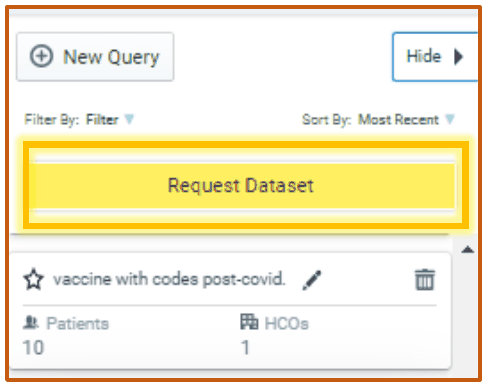
Stony Brook-only datasets are processed by SBM internal TriNetX support, usually within 3 days. This includes a review of your IRB to confirm that the Limited Data Set Form is submitted and that your protocol reflects the cohort you defined.
Research or Linked network datasets must be requested from TriNetX by SBM internal TriNetX support, and take at least 2 weeks. These requests do not need an IRB, since the data is de-identified. However, many publication venues require an IRB determination that the research qualifies as "Not Human Subjects Research", even when Stony Brook datasets aren't used. Check with the venue before you submit.
Getting identified patients
SBM internal TriNetX support (the Honest Broker) can identify the patients in your cohort with the proper IRB approvals. Your query must match the meaning of the inclusion and exclusion criteria the IRB approved.
You might want to identify patients for retrospective or prospective chart reviews, reviews preparatory to research, or subject recruitment. Each patient in the platform has a synthetic identifier that can be matched back to a patient at Stony Brook.
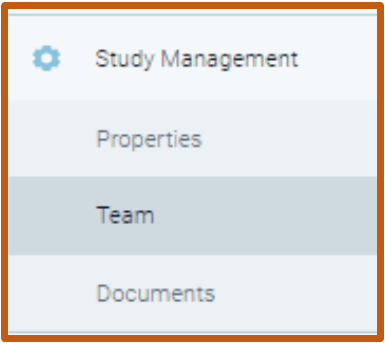
- Share your study with Melanie Keister by adding her to your Study Team (Study Management > Team).
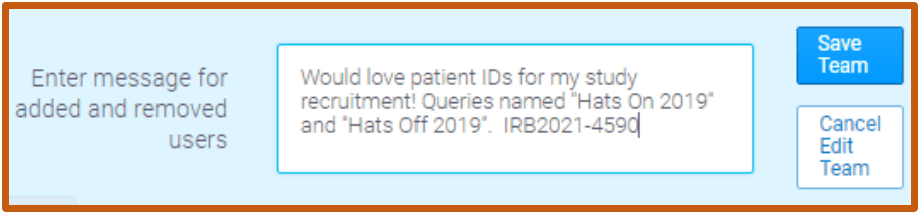
- In the message area, write that you are requesting Patient IDs, then click Save Team.
IRB considerations
Before you request Patient IDs, make sure you have IRB approval to do so. You must also submit a HIPAA Waiver of Authorization with your IRB submission, for permission to access patient PHI for research without the patients' prior consent.
For study recruitment lists, the Honest Broker first filters the potential patients for those who have agreed to be contacted about research studies. These are the rules the Honest Broker uses to decide which patients to identify for recruitment:
- "Yes" in the EMR to being contacted about research: the patient may be identified to a Study Team member from any department, whoever the patient's treatment provider is.
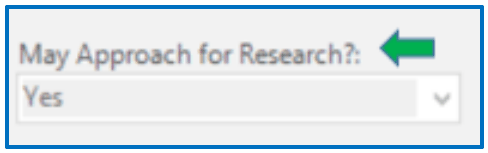
- "No" in the EMR: the patient may only be identified to their treatment provider about a study. The Study Team may be given the name of the patient's treatment provider only.
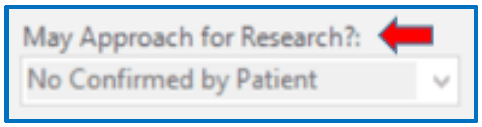
- "Unable to Obtain" or blank: the patient may be identified to either
- the investigator's department, if the investigator sees patients in the same building and practice as the patient's treatment provider, and it is reasonable to assume the investigator would care for the patient when that provider is away; or
- another department where the patient has been seen, if that department has agreed to help the Study Team with recruitment. The Study Team may be given the name of the patient's treatment provider only.
Extra help
TriNetX Real World Data has supporting resources, platform information and how to get help. Documentation and Learning has things like:
- TriNetX Sample Data File
- Sensitive terms restricted to protect PHI in datasets
- Statement of Liability Data Use Agreement
- Protocol templates for TriNetX: Retrospective Chart Review and Limited Dataset Exempt
- Code lookups for ICD, CPT and LOINC