Context and goals
Plasma acceleration of electrons has been a growing area of research since a plasma medium can sustain accelerating forces hundreds of times higher than those of conventional particle accelerators. Researchers are pursuing this technology for use in future colliders, devices that require electron beams combining high charge with excellent quality, making this a significant research challenge addressed through advanced simulation.
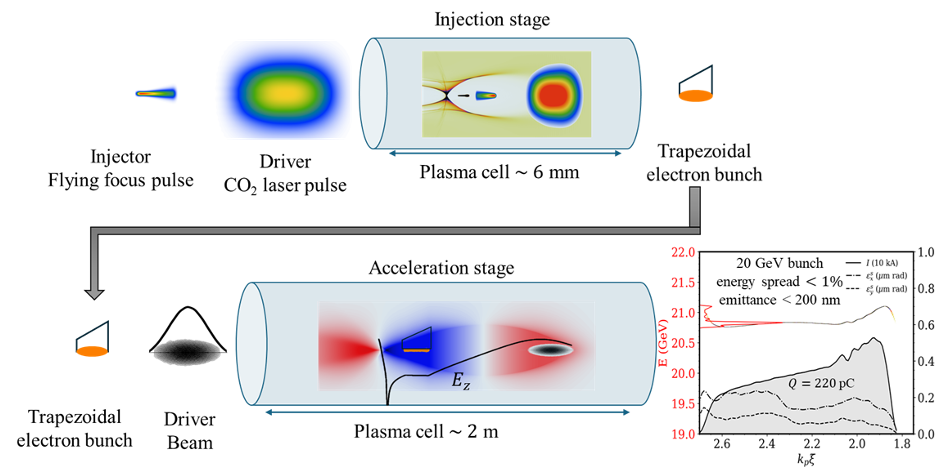
A breakthrough approach involves a fully optical strategy, in which emerging techniques for controlling the spatiotemporal properties of a laser pulse create a high-charge, low-emittance bunch with a specially shaped current profile. This shaped profile produces uniform acceleration, ensuring electrons reach nearly identical final energies, essential for collider applications.
The "flying focus" technique forms the foundation of this method. It uses structured light in which the peak intensity of a laser pulse can propagate at an arbitrarily chosen velocity, including faster than the speed of light in vacuum, enabling innovative approaches for electron injection and acceleration in plasma.
Computational methods
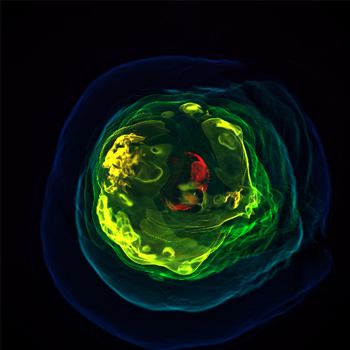
The complexity of modeling laser-plasma interactions at the required resolution (specifically at a wavelength of 400 nm) is addressed by leveraging the SeaWulf HPC cluster. High-resolution simulations are necessary because standard analytical models cannot adequately describe these phenomena. The Osiris particle-in-cell code, developed in collaboration with UCLA, serves as the main computational tool; its specialized module provides an analytic framework for understanding and simulating flying-focus propagation, supporting fully self-consistent simulations driven by the available HPC resources.
Impact
This approach represents the only plasma-based method that currently meets the key performance targets proposed by the particle-physics community for future high-energy plasma colliders. The theoretical framework allows flexible tuning of beam parameters for diverse experimental requirements across advanced accelerator research.
Team & publication
The research is led by Professor Navid Vafaei-Najafabadi's group at Stony Brook University, in dedicated collaboration with the Laboratory for Laser Energetics at the University of Rochester, the Accelerator Test Facility for experimental validation, UCLA for simulation code support, and the University of Texas at Austin. The work is under review at Physical Review X and is available as a preprint at arXiv:2503.09557.