Water is everywhere, and life depends on it. We are about 70% water. Yet despite its ubiquity, water remains one of the most poorly understood liquids. It exhibits striking anomalies, such as a density maximum and unusually high heat capacity, that make it both scientifically fascinating and notoriously difficult to model.
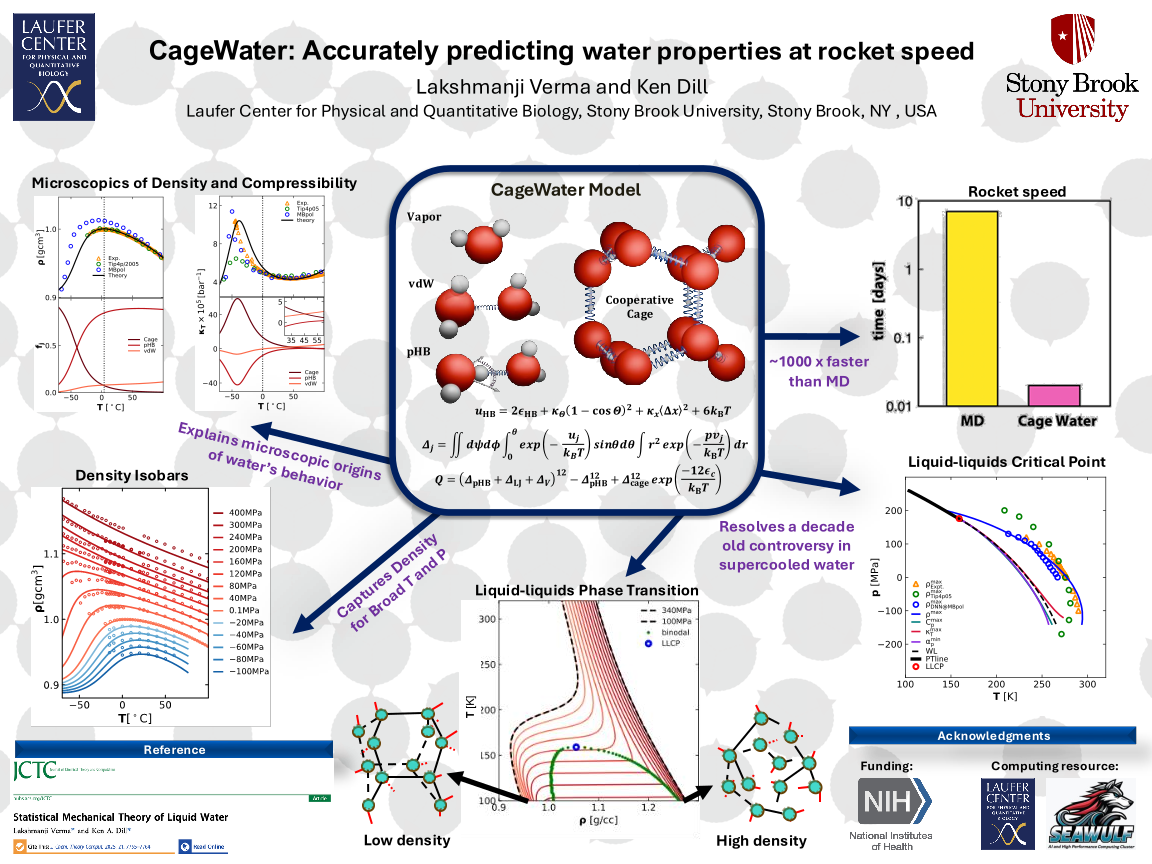
Atomistic simulations remain the most reliable way to reproduce water's behavior, but they are computationally expensive and generally accurate only near ambient conditions. CageWater, from Lakshmanji Verma and Ken Dill at the Laufer Center for Physical and Quantitative Biology, addresses these challenges through a statistical-mechanical, fully analytical model.
1,000× faster, with microscopic insight
CageWater predicts water's properties roughly 1,000× faster than explicit simulations and remains accurate across a wide range of temperatures and pressures. It provides microscopic-level understanding of the origins of water's anomalies, for instance, that its high heat capacity results from the breaking of stronger cooperative bonds. It even resolves long-standing controversial questions about liquid-liquid phase separation and the critical point in supercooled water.
By providing a fast, reliable description of pure water, CageWater also paves the path for solvation and efficient simulations of biomolecules (proteins, DNA, drugs) and chemical materials in aqueous solutions under diverse thermodynamic conditions, accelerating drug discovery and materials design.
Calibrating on SeaWulf
A major challenge, beyond the theoretical development, was calibrating and validating the model against the enormous volume of experimental data available for water. Although CageWater itself can run on any computer, its nonlinear structure and high-dimensional parameter space make heuristic optimization impossible on a standard workstation. Calibration required exploring millions of candidate parameter sets and comparing them against thousands of experimental data points.
To achieve this, the team employed a classical machine-learning approach: a genetic algorithm. Using the Intel Sapphire Rapids nodes on the SeaWulf cluster, they parallelized the evaluation of millions of solutions, enabling rapid evolutionary searches for the global optimum. This large-scale calibration was crucial for identifying the parameters that allow CageWater to match, or in some cases surpass, the accuracy of leading explicit and polarizable water models (TIP3P, TIP4P, TIP5P, SPC, MB-pol) at a tiny fraction of the computational cost.
Reference
Verma, L. & Dill, K. A. Statistical Mechanical Theory of Liquid Water. J. Chem. Theory Comput. 2025, 21(16), 7755–7764.