Every new neuron faces a basic challenge: it has to find enough energy to survive, mature, and become part of an existing brain circuit.
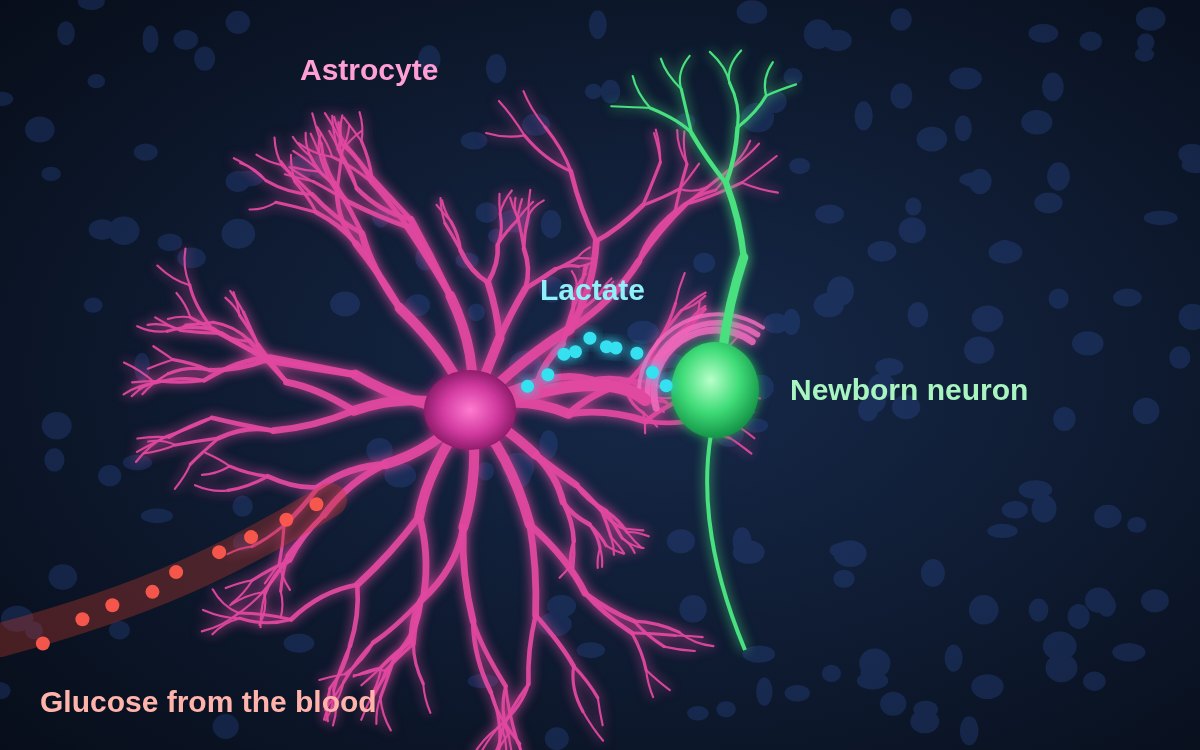
Researchers in the laboratories of Shaoyu Ge and Qiaojie Xiong in Stony Brook's Department of Neurobiology and Behavior set out to learn how newborn neurons in the adult hippocampus meet that energy demand. They combined genetically encoded glucose and lactate biosensors, imaging in freely moving mice, single-nucleus RNA sequencing, genetic manipulation and histology. What they found is a metabolic partnership between astrocytes and developing neurons. When a mouse explores a new environment, nearby astrocytes quickly break down glucose and produce lactate. That lactate reaches the newborn neurons, and the neurons need it to survive.
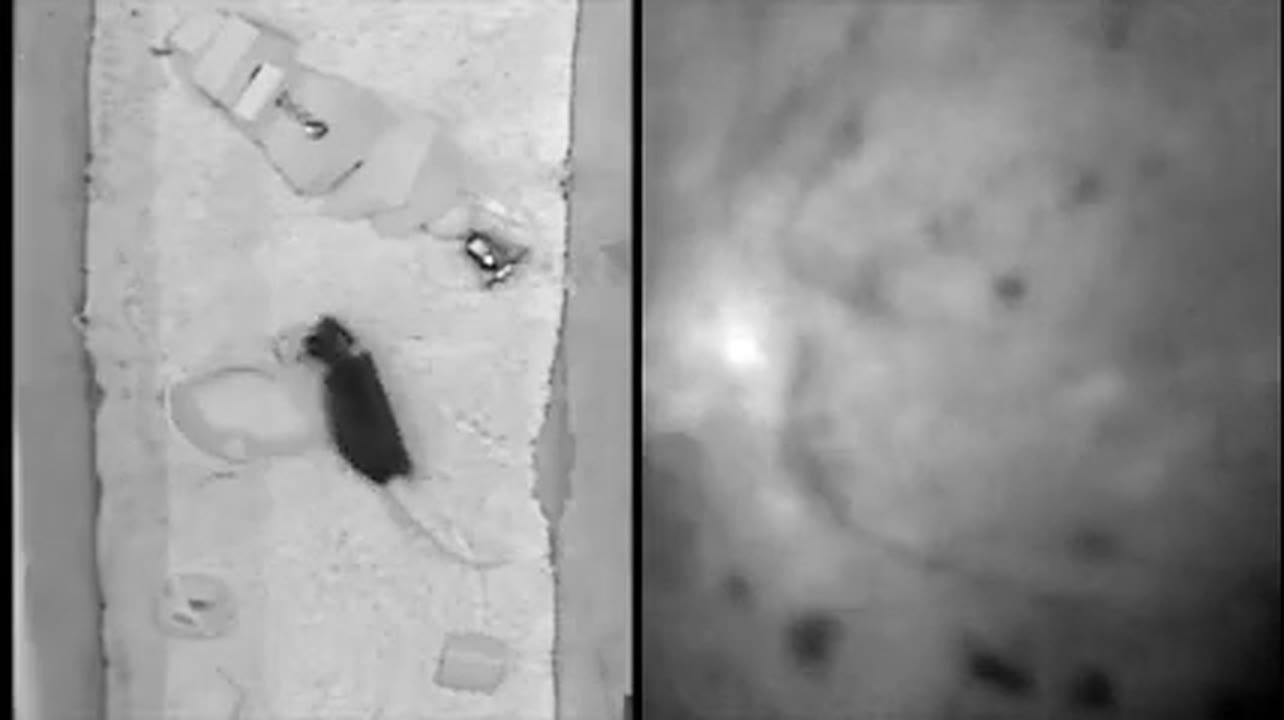
Watch the researcher spotlight: a 17-second look at a mouse exploring while a tiny microscope records blood flow in its hippocampus.
The science in brief
- Newborn neurons refill their own glucose slowly after exploration and have low levels of glucose transport and glycolysis genes.
- The astrocytes wrapped around them are highly glycolytic. Their glucose drops fast during exploration and recovers quickly afterward.
- Lactate rises inside astrocytes and in the space around them while the animal explores.
- Blocking astrocytic glucose uptake (GluT1), lactate production (Ldha) or lactate transport (MCT1) stopped exploration from boosting newborn neuron survival.
To see this, the team had to follow metabolism in the living brain in real time. They imaged newborn hippocampal neurons again and again at different stages of maturation, and measured astrocytic glucose and lactate as each mouse moved from its home cage into an enriched environment and back. Single-nucleus RNA sequencing let them compare the metabolic programs of astrocytes, neural progenitors, immature neurons and mature neurons.
A research project that quickly becomes a data project
Experiments like these produce far more than the figures that end up in a paper. Every imaging session creates raw microscope or miniscope recordings, processed image stacks, behavior videos, intermediate analysis files, spreadsheets, scripts, and several versions of each figure. The sequencing work adds another layer of large datasets and outputs.
As experiments piled up across animals and over several years, storing and moving data reliably became part of the research itself.
Portable hard drives had been one way to carry large imaging datasets from acquisition computers to analysis workstations. They come with real costs, though. Drives have to be bought, labeled, carried, plugged into different computers and eventually replaced. They get hard to keep track of as a project grows, and sharing a dataset among students, postdocs, faculty and collaborators usually means making yet another copy. For a project built on repeated in vivo imaging and several complementary methods, the labs needed one central place to keep and move their data.
Moving research data into Box
Stony Brook's Box service gave them that place. Box provides cloud file storage and sharing for Stony Brook researchers, with unlimited storage and individual files up to 500 GB. Files and folders can be reached from any device and shared with collaborators inside or outside Stony Brook, with document-level version control, encryption, permissions, sync and search built in.
For the hippocampal metabolism project, that means data can be organized around a shared project structure instead of around individual computers or drives. Data from the imaging systems go into project folders, and lab members open them for analysis without carrying a drive from one workstation to the next.
Miniscope recordings, confocal image stacks, behavior videos and sequencing data come off the lab's instruments.
One project folder holds raw data, processed files, scripts and figures, with versions and permissions.
Students, postdocs, faculty and collaborators open the same files from their own workstations.
This matters most for long-running experiments. The study followed glucose in newborn neurons at 1, 2, 4 and 6 weeks after labeling, producing related datasets that have to stay together through acquisition, processing, statistics and figure preparation. A central structure makes it easier to keep those links intact and to keep the original data next to everything derived from it.
Less time moving drives, more time analyzing data
The benefit goes beyond extra storage space. Moving files through Box means the lab no longer depends on portable drives as its main way to carry data. Instead of buying new drives as datasets grow and handing them from person to person, lab members transfer files through Box and give the right people access to the right project folders.
For a lab producing large imaging datasets, that adds up to real savings on drives, and less time spent copying, hunting for and physically moving them.
It also makes the workflow more dependable. If a local analysis copy is lost or a workstation is replaced, the project data are still in Box. Version history and permissions help separate shared project files from personal working copies, Box keeps a record of account activity, and accidentally deleted files can usually be restored within the service's recovery window.
For the Ge and Xiong labs, Box is now where experimental files are stored, moved, shared with the team and kept, without a growing pile of portable drives. What looks like a small change in how data are stored takes a recurring logistical and financial burden off the lab, and gives researchers more time for the scientific questions inside those data.
Working with large research files? Box is available to Stony Brook researchers for storing, syncing and sharing project data. Start with Box at Stony Brook, or use the Research Storage picker to compare Box with academic, clinical and HPC storage.
Reference
Wang X, Chen L, Kim TA, Wang Z, Peng X, Syty MD, Wang F, Zhang Y, Wehrle P, Nasu Y, Xiong Q, Ge S. Astrocytic glucose metabolism regulates the survival of newborn hippocampal neurons in the adult brain ↗. Neuron. 2026 Aug 19;114(16):3061–3076.e7. PMID: 41946358 ↗.