
Phenix provides tools for structure determination, refinement, and validation. The SeaWulf app opens the Phenix graphical interface and loads Coot alongside it for model building.
On this page: Where it runs · Start a session · Launch settings · Troubleshooting
Where it runs
| Cluster | Runs on |
|---|---|
| SeaWulf | Shared CPU queues on 40-core or 96-core nodes |
Start a session
- Sign in to the OnDemand portal for your cluster (SeaWulf) with your NetID and Duo.
- Open Interactive Apps and choose Phenix.
- Choose the launch settings below and click Launch.
- After the session starts, Open OnDemand provides Compression and Image Quality controls for the remote desktop display. Compression controls how strongly the graphical display is compressed before being sent to the browser. Higher compression can improve responsiveness on slower network connections but may reduce visual quality. Image Quality controls the quality of the displayed image. Higher values provide a sharper display but may require more network bandwidth. For most sessions, the default settings are appropriate. Adjust them only if the desktop appears slow, blurry, or unresponsive.
- Open or create a project and choose the Phenix task you need. Keep the model, data, and output together in a project directory.
- Save your work or export the results, then click Delete on the session card when finished. Closing the browser tab does not stop the session.
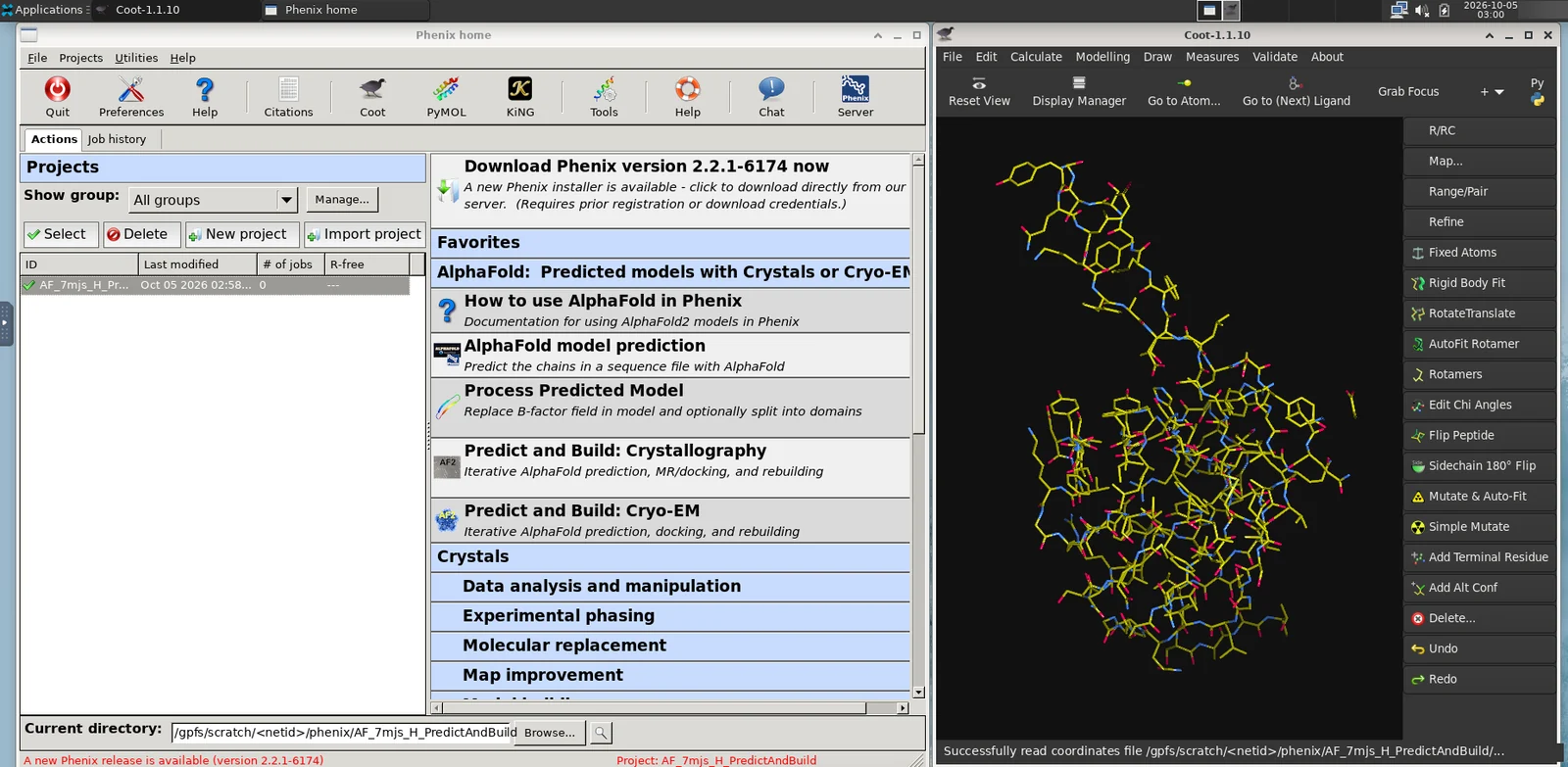
Launch settings
Defaults below are starting points. Ask for resources your task needs, and keep the requested hours within the selected queue limit.
| Setting | What to choose |
|---|---|
| Phenix version | Version 2.0-cpu. |
| Coot version | Version 1.1.10. |
| Queue | Shared CPU queues on 40-core or 96-core nodes. Short up to 4 hours; long up to 24; extended up to 84. Start with short-40core-shared or short-96core-shared. |
| Working directory | Defaults to your home folder. Choose the folder containing your project or data. Enter a full path. |
| Hours | Default 1 hour. Choose enough time for your work, within the selected queue limit. |
| Cores | Default 4; form range 1 to 96. Use only as many cores as the task can use, within the selected node capacity. |
| Memory (GB) | Default 16 GB. Choices: 4, 8, 16, 32, 64, 128, 164 GB. |
Email notifications are optional. Enter an email address and select Email when job starts if you want a start notification.
Choose an explicit memory size for routine work. All available can reserve node memory and increase waiting time; use it only when your task needs it.
Troubleshooting
Coot does not open from Phenix. Check the session output for Coot module or launch errors. Include both selected versions when contacting support.
A refinement needs more resources. Set the task processor count within your allocation. Relaunch with more memory or time if the selected calculation needs it.
The graphical interface opens but a task fails. Read the task log for the first error. Check input file paths and task settings before relaunching the whole session.
My session stays Queued. Try a shorter request, less memory, or fewer cores. Check the session output if the job fails instead of remaining queued.
If the problem continues, contact HPC support with the cluster, app name, job ID, and the error text.