From the golden years of a white dwarf to its ultimate fiery and explosive demise, Josh Martin of Stony Brook University's Institute for Advanced Computational Science investigates the triggers of thermonuclear catastrophes.
A white dwarf is the exposed stellar core of a formerly low-mass star, like our sun. Isolated, a white dwarf quietly cools into darkness; but with a companion, it can meet a far more destructive fate. When matter from a companion star flows onto a white dwarf, it can trigger a thermonuclear runaway resulting in one of the brightest explosions in the universe: a Type Ia supernova.
Because they are so similar in brightness, these supernovae can be used as standards of measurement for far-reaching cosmological distances. That utility led to the Nobel Prize-winning (2011) discovery that our universe is expanding at an accelerating rate, and thus to the formulation of the energy responsible for that acceleration: dark energy.
Type Ia supernovae are not, however, monolithic. Age and composition can affect brightness, and there are a host of subgroups that don't quite fit the "Type Ia" mold. The question becomes: what are these other events, and why do they occur in the first place?
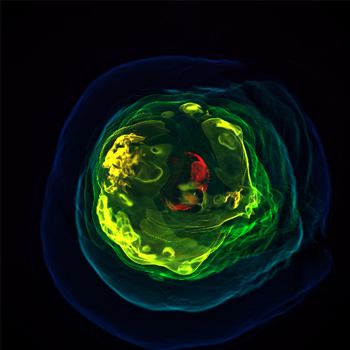
Josh Martin, a Ph.D. student at IACS and one of SeaWulf's top users over the past year, is trying to help answer it. He specifically investigates one of the largest subgroups of Type Ia supernovae, "Type Iax supernovae", a dim class with characteristically lower explosion energies.
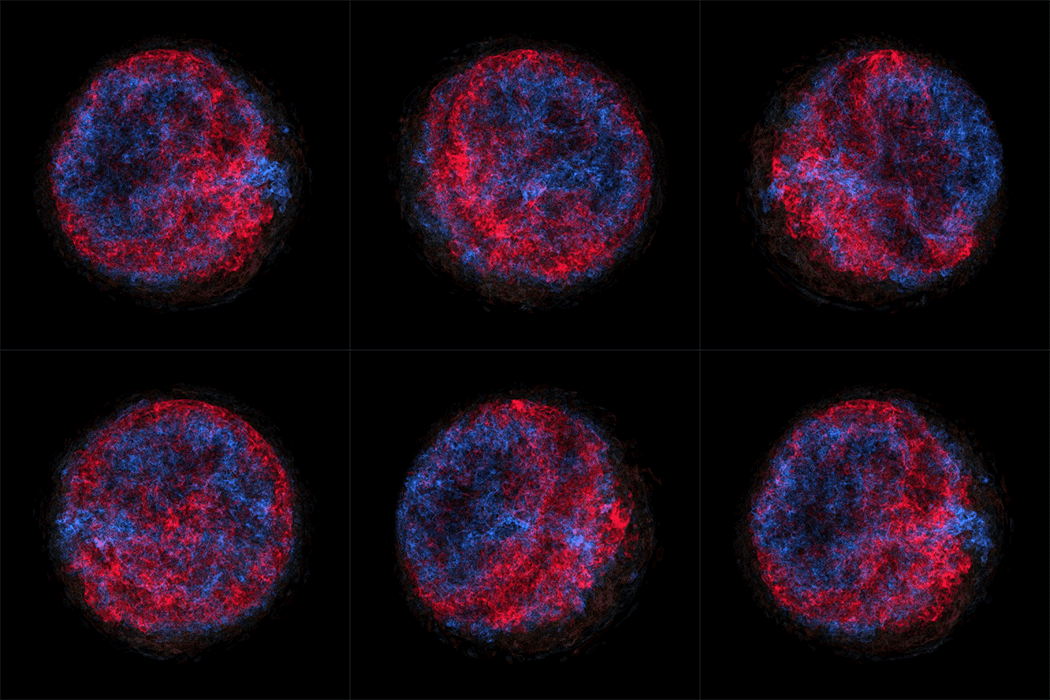
Martin investigates these Type Iax supernovae with a massive 3D simulation powered by the FLASH code, a multi-scale, multi-physics, highly parallelized modular research code designed for compressible reactive flows. These events are inherently multi-dimensional, and capturing the underlying physics (e.g. turbulent combustion) requires advanced platforms like SeaWulf for any hope of progress. At its peak, this grid-based simulation contains over 1,000,000 3D blocks, each containing 16×16×16 cells that each store 20 variables. That amounts to nearly 100 billion variables that must be evolved every timestep.
Martin's simulations are performed exclusively on the SeaWulf HPC cluster, which harnesses cutting-edge Intel Xeon Max Sapphire Rapids nodes with High Bandwidth Memory (HBM). Because FLASH is typically limited by memory bandwidth, the HBM on the Sapphire Rapids nodes delivered a substantial performance advantage. The project also benefited from the ability to scale efficiently across nearly forty 96-core nodes, enabling much larger and more detailed runs than would otherwise be possible.
Nearing completion is Martin's paper revealing the results of these Iax simulations: a near-central explosion mechanism consistent with the chemical and energetic yields detected in observational studies. Martin is hopeful his work will illuminate how these particular explosions fit into the cosmic story we're still learning to tell.